
18 September 2026 —
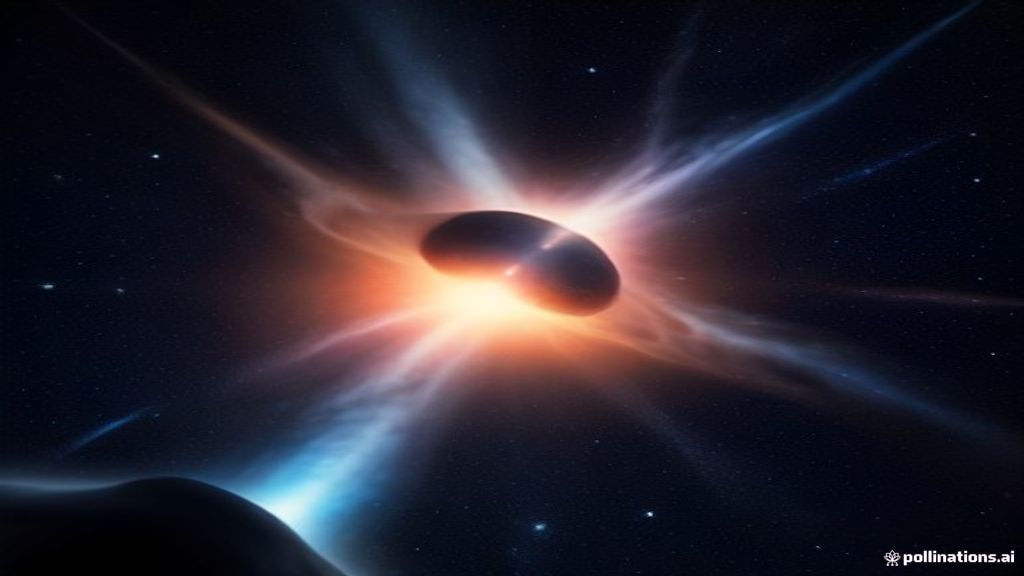
Astronomers have unlocked a longstanding cosmic mystery, determining precisely when and why supermassive black holes launch powerful black hole jets into space after consuming nearby stars. The breakthrough study sheds light on the violent phenomenon known as a tidal disruption event, where a star’s catastrophic destruction triggers delayed eruptions of high-energy particles.
When a roaming star strays too close to the immense gravitational pull of a supermassive black hole, extreme tidal forces stretch and tear the star apart. While a significant portion of the stellar debris falls into the accretion disk, a substantial fraction is flung outward. Astronomers have long observed that these cosmic giants often emit intense bursts of radio waves and plasma—popularly referred to as cosmic burps—months or even years after the initial stellar consumption occurs.
The new research explains the precise timing and mechanisms behind these delayed outflows. Scientists discovered that as the stellar material gradually settles into a rapidly spinning disk around the event horizon, surrounding magnetic fields slowly intensify. Once these magnetic forces reach a critical threshold, they channel superheated, magnetized plasma away from the black hole, launching relativistic jets across vast distances in space.
Previous observational models struggled to explain why some black holes launch jets immediately after destroying a star, while others experience significant delays before erupting. By analyzing multi-wavelength data captured by space and ground-based observatories, the research team demonstrated that the delay correlates directly with the density of the surrounding environment and the time required for the accretion disk to stabilize.
This fundamental insight alters how astrophysicists track supermassive black holes in distant galaxies. By establishing a clear timeline for post-ingestion flare-ups, astronomers can now predict when secondary radio emissions will peak, allowing global telescope networks to capture high-energy cosmic explosions in real time.
The findings mark a major step forward in understanding galactic evolution and black hole dynamics. As next-generation observatories come online, researchers expect to monitor hundreds of stellar disruption events annually, further unraveling how these cosmic behemoths shape the universe around them.
Useful links
Tourism & Management · Citizen Responsibility · Skill Services · Ramesh Poudel
Published with WpNewblog — www.rameshpoudel.com
About the Author